
The national award for ‘Best Patent by a Young Inventor’ stays at the UA

Blanca Calderón has received the award for creating a new circular economy system to obtain iron nanoparticles from the residue of olive oil production | It is patented by the University of Alicante.
Chemical engineer Blanca Calderón Roca has received the national award for ‘Best Patent by a Young Inventor’ for creating a system to obtain iron nanoparticles from the residue of olive oil production. A system that arose from Calderón’s doctoral thesis —which was supervised by the Chair of Chemical Engineering at the University of Alicante (UA), Andrés Fullana, who is a co-inventor— and which is patented by the UA.
The inventor, 37 years old, received the award on June 14 at the second edition of the Awards for the Best Invention Protected by Industrial Property granted by the Spanish Patent and Trademark Office (OEPM). A recognition that surprised and delighted the inventors. “We are both super happy, we didn’t expect it,” Calderón told this newspaper.
As she herself acknowledged, “when you are young and decide to start researching” you don’t know what you will find. Along the way she encountered a series of doubts, such as not being sure whether her research “would be useful for anything.” But it has been useful, since the discovery that emerged in a doctoral thesis has become a patent and a business model that not only jumps on the circular economy and environmental care bandwagon but also “generates wealth.”
The winning patent is called ‘Nanoparticles for environmental decontamination from agricultural residues’ and was selected by prestigious experts in the field of industrial property from more than 100 national patent and utility model applications granted by the OEPM in 2021.
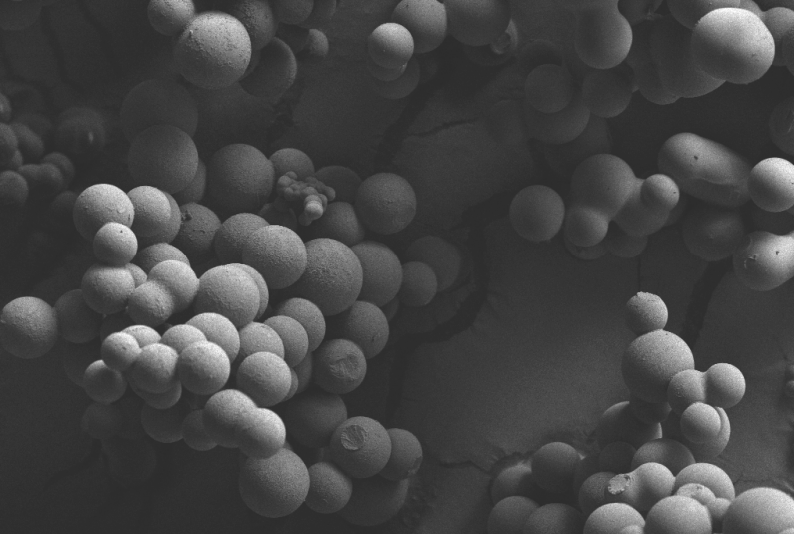
So, what does the system consist of? Calderón and Fullana, together with the ‘Engineering for the Circular Economy’ research group at the University of Alicante, have developed a low-cost procedure that allows obtaining iron nanoparticles coated with a thin layer of graphite, with high purity and without waste generation, from an agricultural residue that contains polyphenols.
The residue used in the system is a carbonaceous material with a high content of polyphenols: alpechín, which results from the process of producing olive oil. Therefore, it is a project that “fulfills the principles of the circular economy 100%,” as Calderón has pointed out. It is a residue that “is not being used for anything” and with the procedure becomes a product of “great value.”
Manufacturing in “industrial quantities” and environmental utility
The inventor explained that this technology can be applied in different industrial fields —such as electrochemistry and renewable energies— as well as to carry out the removal of contaminant agents in water, air and soil. In fact, it has already been scaled up industrially by the company Calpech, which is part of the Science Park of the University of Alicante.
The company was founded in February 2021 based on the patent, but in its origins it was more dedicated to research and pilot trials. However, according to Blanca Calderón, for approximately six months it has been manufacturing the product in a plant installed in Extremadura and selling it in “industrial quantities.”
Calpech is responsible for producing the nanoparticles and selling them “for environmental applications” to different companies. And they are not sold by the kilo, but by the ton. Meanwhile, the research team continues its activity in the laboratories and other facilities of the UA Science Park.
In addition, the project received one of the UA’s Impulsa awards and currently still has funding from the Public Aid for Technology-Based Companies (Neotec) offered by the Centre for the Development of Industrial Technology of Spain (CDTI) —dependent on the Ministry of Science and Innovation—.
Transfer of innovative technology: the UA’s objective
The UA bets on the transfer of innovative technology as one of its priority activities. A task carried out by the Vice-Rectorate for Innovation Transfer and Scientific Outreach, headed by María Jesús Pastor Llorca, and for which there is a Research Results Transfer Service (OTRI). The service is made up of different experts and technicians and is directed by Víctor Pérez Lozano.
Lozano, who has been in charge of the OTRI for more than five years, has stated that “one of the vice-rectorate’s priorities is the protection of knowledge.” A factor he considers of vital importance since “protected knowledge, for example by patent or utility model, can be offered to our socio-economic environment with exclusivity or monopoly in its exploitation, making it more attractive to companies.”
The UA increasingly files for Industrial and Intellectual Property modalities and reaches an average of almost 20 patents per year
The director of the OTRI also explained that the UA increasingly files for patents and other modalities of Industrial and Intellectual Property. In fact, he said that it reaches an average of almost 20 patents per year and that international protection is requested (via PCT) in 80% of cases. In addition, over the last 5 years, applications to the European and American Offices have doubled, according to data shared by the institution, and the routes of Industrial Property that the university mainly uses develop in different areas.
On one hand there are patents, which are technical inventions with the requirements of novelty, inventive activity and industrial application; and on the other hand utility models, which have similar requirements but to a lesser degree. In addition, according to the UA itself, the institution is one of the pioneering universities in protection via Trade Secret —for knowledge whose protection by patent would not be possible or would be inadvisable—.
These protected research results can be transferred to companies in different ways, such as in the form of collaborative research or licensing. “That effort in protecting knowledge is bearing fruit when licensing knowledge to our socio-economic environment,” Víctor Pérez has defended. In this regard, the director of the OTRI stated that, as of December 2022, a figure close to “40 license contracts in force” has been reached.
Who owns the patents developed at the UA?
The patents or utility models that scientists develop at the University of Alicante belong to the academic institution, although the UA recognizes them a high percentage of participation in the economic rights obtained by granting the corresponding licenses to companies. In the case of Blanca Calderón and Andrés Fullana, the company derived from the patent has the exclusive rights to manufacture and sell the product.
Related Posts
También te puede interesar
Why is Spain still far…
Read MoreComparison between biogas and other…
Read MoreReducing costs with nanoparticles in…
Read MoreIncreasing biogas with iron nanoparticles
Read MoreManagement of Agroindustrial Sludges and…
Read MoreProcess Improvements in Anaerobic Digestion
Read More